
Table of Contents
- What Is Digital Experience Management (DEM)?
- The Benefits of Digital Experience Management
- Why Digital Experience Monitoring Matters
- Measuring Application Responsiveness and Real Transaction Times
- Understanding User Journey Monitoring and Experience Metrics
- Performance Optimization Through Real-Time Insights
- How ObserveLite DEM Brings It All Together
- Conclusion: From Monitoring to Meaningful Experiences
What Is Digital Experience Management (DEM)?
Today, customers expect seamless, intuitive, and instant digital interactions—whether they’re making a payment, tracking a shipment, or logging into a portal. Digital experience management (DEM) is how organizations ensure that every one of those interactions works the way it should.
In simple terms, DEM is the practice of measuring and improving how users actually experience your applications. It goes beyond traditional uptime monitoring to understand what users see, feel, and encounter as they move through your platform.
Modern DEM brings together front-end monitoring, real-time analytics, and experience insights to bridge the gap between technical performance and human satisfaction.
The Benefits of Digital Experience Management
While many businesses focus on backend infrastructure, digital experience management turns the spotlight on what truly matters—the customer’s perception.
Here’s why DEM has become essential for organizations in industries like banking, healthcare, and retail:
- Better customer satisfaction: By tracking customer experience metrics, teams can identify slow or confusing moments in a user’s journey and fix them before frustration sets in.
- Reduced drop-offs: When application responsiveness lags, users tend to abandon tasks. DEM tools detect these moments and help optimize them, minimizing revenue loss.
- Improved operational efficiency: DEM reduces guesswork. Teams no longer chase false alarms—they act based on verified user data.
- Competitive differentiation: Businesses that deliver consistent, fast, and reliable digital experiences stand out in crowded markets.
- Proactive issue resolution: With real-time insight into performance optimization, organizations can predict issues before they impact users.
In short, DEM helps align technology performance with business outcomes—transforming monitoring from a technical necessity into a competitive advantage.
Why Digital Experience Monitoring Matters
You can have the best infrastructure and still deliver poor user experiences. That’s because most legacy monitoring tools only track what’s happening inside your systems, not how those systems perform for the user.
Digital experience monitoring changes that. It brings visibility to how users interact with your application, what’s slowing them down, and how performance issues affect satisfaction or conversion.
From page load times to network latency and transaction completion rates, DEM surfaces insights that help teams build smoother, faster experiences. And when combined with observability and APM, it creates a full 360-degree view—technical health aligned with real-world user journeys.
Measuring Application Responsiveness and Real Transaction Times
Ever clicked “Submit” on a form and waited endlessly for confirmation? That’s where application responsiveness makes or breaks trust.
DEM tools measure how long it takes for each component—backend APIs, network calls, and UI elements—to respond during real-world interactions. By tracking real transaction times, businesses can see where performance breaks down.
For example:
- Is the delay caused by a third-party API?
- Does the mobile experience differ from the desktop one?
- Are users in a specific region facing longer load times?
By connecting these insights, DEM transforms raw metrics into actionable improvements that users actually feel.
Understanding User Journey Monitoring and Experience Metrics
A customer’s journey rarely follows a straight line. They might start on your website, switch to mobile, and finish their action through an app.
User journey monitoring maps every step of that flow. It identifies which stages are smooth, which ones cause friction, and how long each transition takes.
Through integrated experience metrics like dwell time, task success rates, and abandonment points, teams can pinpoint what’s working and what isn’t.
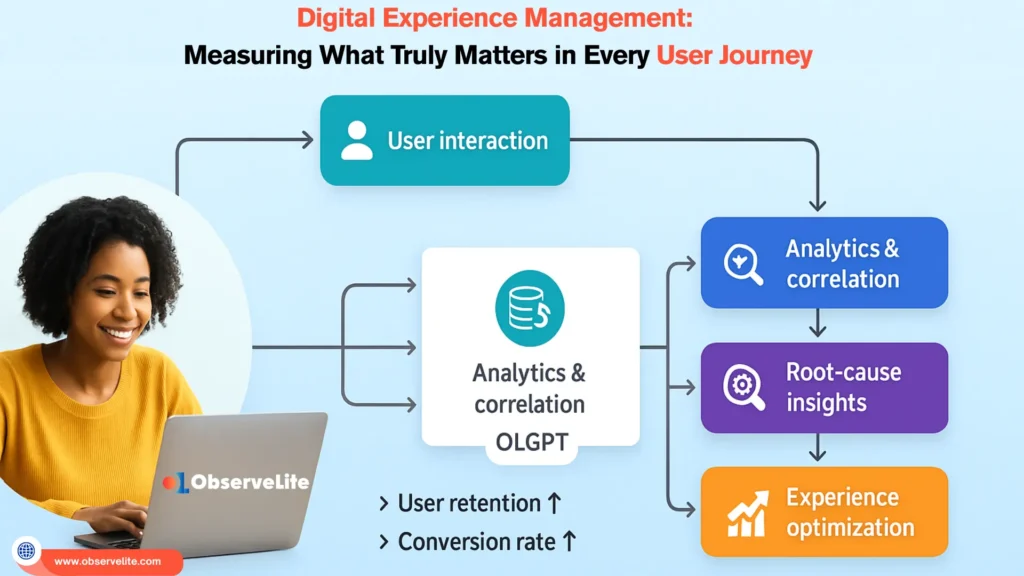
With ObserveLite’s DEM, you can visualize entire user journeys—from login to checkout—revealing bottlenecks that traditional analytics tools miss.
Performance Optimization Through Real-Time Insights
Optimization isn’t just about speed—it’s about making experiences consistent and reliable.
ObserveLite’s DEM platform blends real-time data with performance optimization intelligence to keep your systems agile. Instead of waiting for an outage or a support ticket, you see problems as they form and address them immediately.
By combining end-user analytics with backend visibility, your teams can:
- Detect early warning signs before downtime.
- Correlate issues with user impact.
- Deploy fixes that matter most to customer satisfaction.
It’s continuous improvement, powered by real-world feedback.
How ObserveLite DEM Brings It All Together
At ObserveLite, we designed our digital experience management solution to make every digital interaction measurable, predictable, and improvable.
Our platform unifies real user monitoring (RUM), synthetic testing, and journey analytics to deliver a complete picture of how users engage with your systems.
Whether it’s tracking application responsiveness, optimizing mobile experiences, or understanding real transaction times, ObserveLite DEM ensures every touchpoint works exactly as intended.
What makes ObserveLite stand out is our OLGPT engine—a generative AI-powered analytics core that interprets patterns, detects anomalies, and even recommends fixes automatically.
Instead of drowning in dashboards, your teams get clear, contextual insights—so you can act faster and smarter.
Conclusion: From Monitoring to Meaningful Experiences
Technology alone doesn’t create loyalty—experience does.
And that’s where digital experience management earns its place as a strategic priority, not just an IT function.
By combining user journey monitoring, application responsiveness tracking, and performance optimization, organizations can deliver experiences that are not only reliable but remarkable.
At ObserveLite, our mission is simple: help businesses see their digital world the way users do—clearly, intelligently, and completely.
Because every millisecond, every click, and every customer interaction tells a story. DEM ensures it’s a story worth remembering.
